THE TRUTH DOESN'T OWE EITHER PARTY AN APOLOGY:
Why Moral Convictions, Intellectual Honesty, and Presidential Accomplishments Still Matter
Honesty, intellectual integrity, and the pursuit of truth are foundational to who I am. I don't deliberately deflect, distort facts, or ignore evidence simply because it challenges my position.
If I'm wrong, I want to know it. But I also refuse to abandon a well-reasoned conviction simply because it happens to be politically unpopular. I believe truth matters more than party loyalty, and principles matter more than personalities. That's not just something I say. It's the standard I genuinely try to live by.
And that brings me to something I believe is critically important.
I see profound moral, philosophical, and constitutional differences between the directions today's Democratic and Republican parties are taking. That doesn't mean Republicans are inherently virtuous or Democrats inherently wrong. Neither party has a monopoly on wisdom, integrity, or wrongdoing. But acknowledging faults on both sides does not require pretending that their competing principles, priorities, and policies are morally equivalent.
When it comes to constitutional government, religious liberty, the sanctity of human life, national sovereignty, individual responsibility, and freedom, I believe those differences are substantial, consequential, and impossible to dismiss.
My concerns about the Democratic Party's ideological direction are hardly mine alone. Even moderate Democrats have publicly challenged the growing influence of the Democratic Socialists of America (DSA), particularly its positions on capitalism, policing, immigration, Israel, and American foreign policy.
This isn't merely conservative criticism. Democrats themselves have organized around defending capitalism, fiscal responsibility, border security, and more traditional Democratic policies. The 2026 Promise to America initiative reflects that internal struggle.
And consider the increasingly visible political relationships between the Democratic establishment and democratic-socialist candidates:
Barack Obama praised El Sayed and Zohran Mamdani's campaign and offered advice. Kamala Harris supports El Sayed, Elizabeth Warren, and Kathy Hochul supporting his and have supported Mamdani's candidacy. Meanwhile, Alexandria Ocasio-Cortez, Rashida Tlaib, Mamdani, and other politicians have more direct connections to the democratic-socialist movement.
Now, I'm not suggesting every Democrat is a socialist, nor that endorsing a socialist candidate automatically means embracing the DSA's entire platform. That would be an unfair conclusion, and I won't make it.
But neither should we pretend these alliances are politically insignificant. They raise serious and legitimate questions about the direction of a major American political party.
Where does the Democratic Party ultimately intend to draw the line between regulated capitalism and democratic socialism? Between necessary immigration enforcement and proposals to abolish ICE? Between legitimate criticism of Israeli government policies and opposition to Israel's legitimacy? Between reforming law enforcement and undermining its ability to protect communities?
These aren't imaginary distinctions. They're substantive policy disagreements with real consequences for Americans and our allies.
And when moderate Democrats themselves are raising similar concerns, those concerns deserve to be examined rather than dismissed as partisan fearmongering.
Now, concerning Donald Trump, I believe we owe history something better than judging a presidency primarily through the lens of personality, rhetoric, or partisan hostility.
Presidents should be evaluated by what they attempted, what they accomplished, what changed because of their leadership, and whether those changes produced lasting benefits.
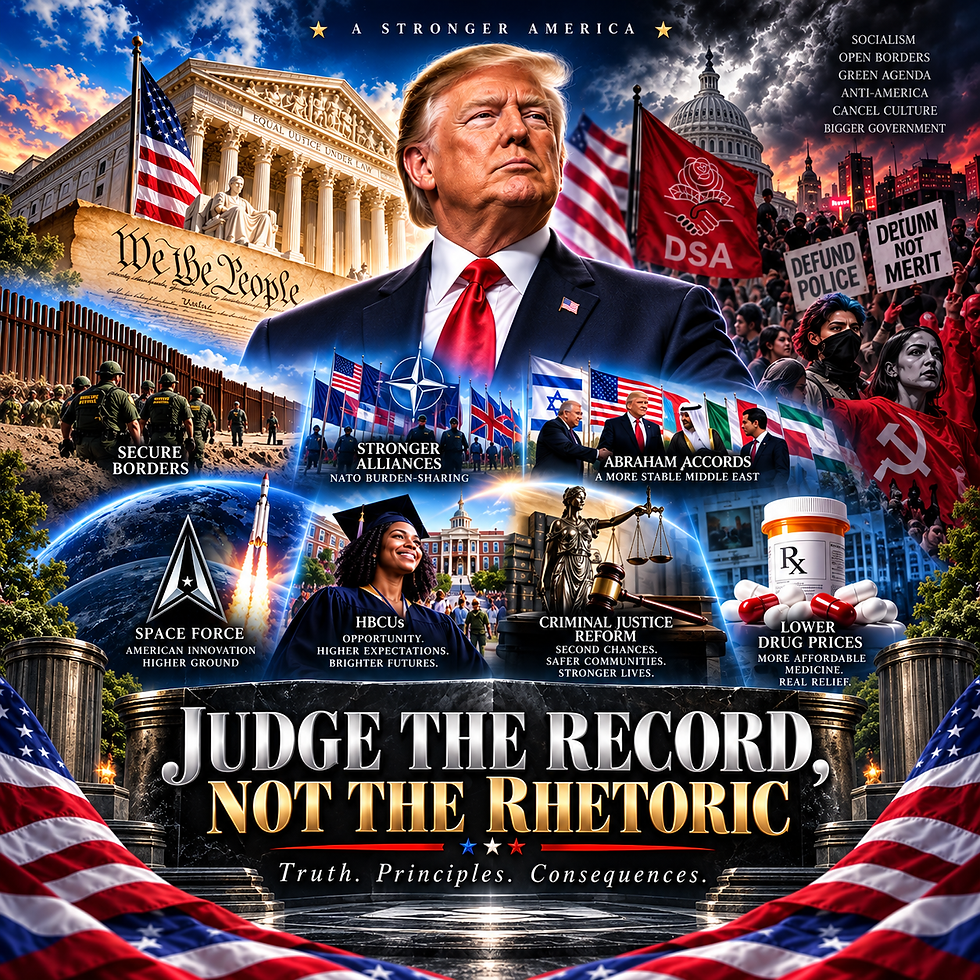
By that standard, Trump's record includes consequential achievements that deserve serious historical consideration.
His three Supreme Court appointments helped produce the Dobbs decision, overturning Roe v. Wade after nearly half a century. Whatever one's position on abortion, that was a historic transformation of American constitutional jurisprudence.
His judicial appointments more broadly have influenced constitutional interpretation, religious-liberty questions, administrative law, and the relationship between government authority and individual rights.
His administrations have pursued conscience protections and religious-liberty policies important to millions of Americans.
His border-enforcement initiatives have produced substantial measurable reductions in unlawful crossings and apprehensions.
He established the United States Space Force, the first new independent American military service in more than seven decades.
He pressed NATO allies to assume greater responsibility for their own defense, contributing to major new defense-spending commitments.
He helped broker the Abraham Accords, opening diplomatic relationships between Israel and Arab nations that had previously lacked formal normalization agreements.
His tax legislation, deregulation initiatives, and trade reforms—including the USMCA—represented significant changes in American economic policy. Their full economic benefits and costs deserve examination, but their significance as policy accomplishments should not be ignored.
And we shouldn't overlook what Trump has done in areas that directly affect minority communities.
He signed the bipartisan First Step Act, one of the most consequential federal criminal justice reforms in decades. It reduced certain excessive federal sentences, expanded rehabilitation opportunities, and made portions of earlier sentencing reforms retroactive. These changes addressed inequities that had disproportionately affected Black Americans and other communities.
He also signed the FUTURE Act, establishing permanent annual federal funding of $255 million for historically Black colleges and universities and other minority-serving institutions. That represents a tangible investment in education and opportunity. Importantly, it was a bipartisan accomplishment, and I'm perfectly willing to give Congress credit alongside the president.
His administration also established Opportunity Zones to encourage private investment in economically distressed communities. Whether every community has benefited equally is a fair question, but attracting investment and creating economic opportunities in neglected areas was a substantive policy objective.
And consider his efforts to confront the extraordinary cost of prescription medications.
Americans have spent years paying significantly more for certain drugs than patients in other developed countries. Trump has challenged that disparity through his most-favored-nation pharmaceutical pricing initiative.
His administration has negotiated agreements with 26 pharmaceutical manufacturers, representing approximately 89% of the branded prescription-drug market, according to the administration's August 2026 announcement. Those agreements are intended to bring qualifying American drug prices closer to the lowest prices paid in comparable developed nations.
His administration also launched TrumpRx to make discounted medications available through a direct-to-consumer platform and pursued lower prices for state Medicaid programs.
Now, these are meaningful pharmaceutical policy developments. Not every medication is covered, not every patient's out-of-pocket costs will fall, and the full long-term savings remain to be established. But the agreements themselves are real initiatives addressing a problem that has burdened American families for decades.
To me, that matters. Affordable medicine isn't merely an economic issue. For families choosing between prescriptions, groceries, and other necessities, it's a profoundly human concern.
And his willingness to confront Iran's nuclear ambitions represents another consequential national-security initiative. Preventing an extremist Iranian regime from acquiring nuclear weapons is an objective with enormous implications for Israel, the United States, the Middle East, and potentially the world.
Whether those military and diplomatic efforts produce a durable, verifiable solution remains to be seen. I readily acknowledge that. But I also believe meaningful action against a serious threat deserves recognition, even before every long-term consequence is known.
That's an important distinction, brother.
There are accomplished results, there are initiatives already producing measurable results, and there are initiatives whose ultimate outcomes are still developing. Intellectual honesty requires distinguishing among them—not dismissing all three simply because we dislike the person responsible.
And yes, we must account for the economic consequences of international conflict, including the effects of the Iran war on energy prices. A fair assessment examines those costs alongside the national-security objectives and potential benefits.
I'm not claiming Trump is flawless. He certainly isn't. Nor am I claiming that historians have established him as one of America's five greatest presidents.
What I am saying is that his record contains historically consequential accomplishments in judicial jurisprudence, pro-life policy outcomes, minority education, criminal justice reform, border enforcement, military organization, NATO burden-sharing, Middle Eastern diplomacy, and efforts to make prescription drugs more affordable.
Those achievements merit serious consideration in any assessment of presidential leadership.
And frankly, I don't believe intellectual honesty permits us to minimize accomplishments simply because we dislike a president's personality, any more than it permits us to exaggerate his successes because we admire him.
The standard must work both ways.
Brother, I have spent much of my life believing that ideas have consequences, that truth is discoverable, and that moral distinctions matter. Those convictions don't disappear when the conversation turns to politics.
I don't believe every political disagreement is merely a difference of equally valid opinions. Some positions are better supported by evidence. Some principles are more consistent with constitutional liberty. Some policies produce better results. And some moral distinctions are genuinely consequential.
Recognizing that isn't intolerance or blind partisanship. It's exercising discernment.
My allegiance isn't to Donald Trump, the Republican Party, or any political personality. It's to the principles I believe are true, morally defensible, and worth preserving.
I'll acknowledge a Democrat's accomplishments when they're deserved, and I'll criticize a Republican's failures when the evidence warrants it. I expect to be held to that same standard.
But I won't embrace a false equivalence merely to appear politically balanced. Fairness means applying the same standard to everyone—not pretending that every competing policy, ideology, or consequence is equally defensible.
And perhaps most importantly, brother, none of this changes how much I value our friendship.
We should be able to disagree passionately, challenge one another's reasoning, question assumptions, and even reach very different conclusions without questioning each other's sincerity or integrity.
You don't have to agree with my conclusions. But recognize that they come from thoughtful consideration, deeply held convictions, and a genuine desire to get things right.
I would much rather have a friend who challenges my thinking than one who merely agrees with me. But I also hope that friendship leaves room for us to disagree without assuming the worst about each other's motives.
After all, intellectual honesty doesn't require agreement. It requires a willingness to follow the evidence, acknowledge inconvenient facts, and apply our principles consistently—even when doing so is uncomfortable.
That's the kind of friendship I value. One where truth matters more than winning an argument, convictions are respected even when disputed, and friendship remains stronger than politics.
Mike "MoonDog" Burnette
Opinionated By Day, Novelist By Night!

Comments